
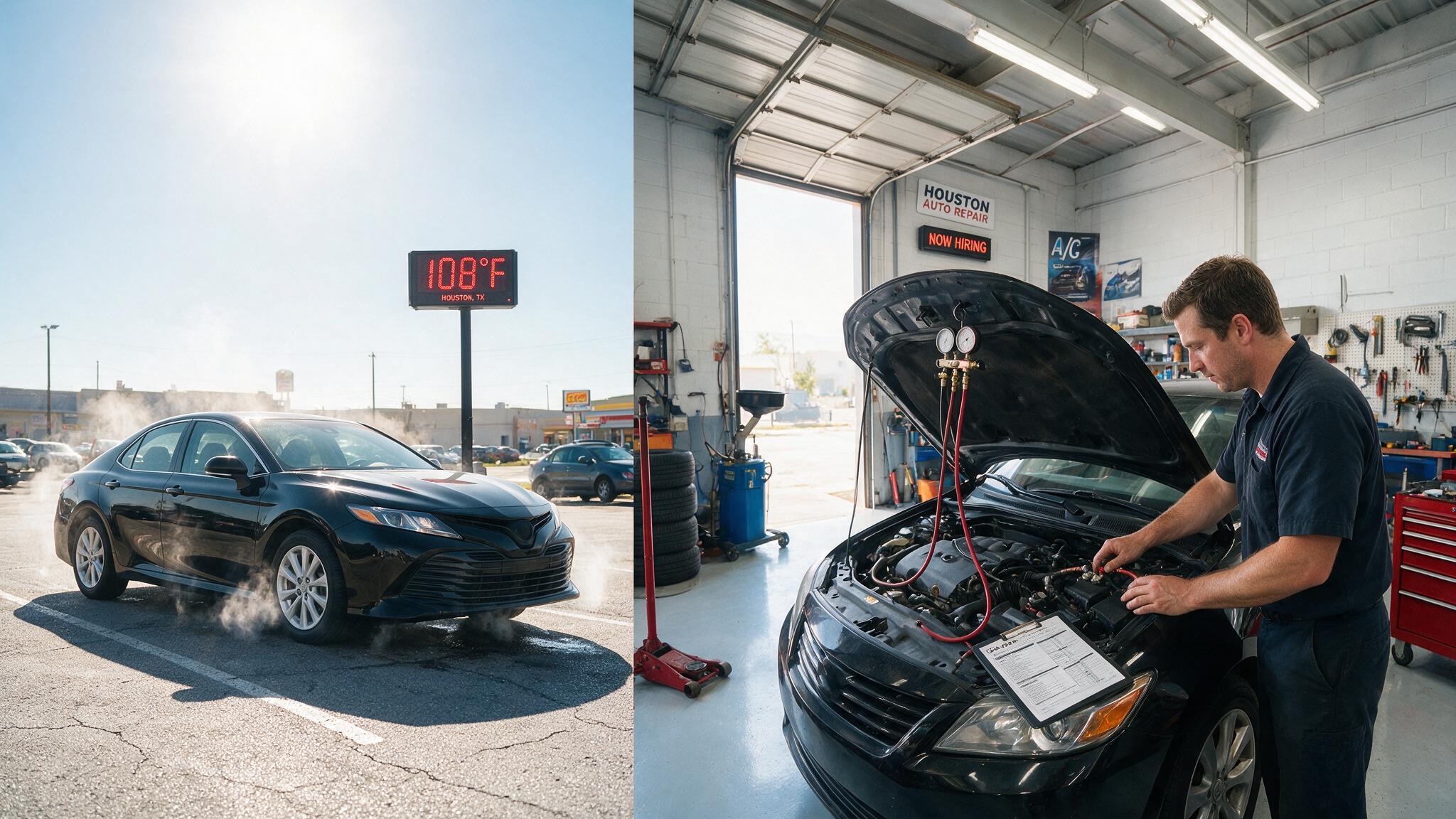
How Houston Heat Affects Your Car’s Air Conditioning
Houston heat doesn’t automatically mean something is wrong with your car’s A/C, but high outdoor temperatures can make the system work harder to cool the cabin. Stop-and-go traffic and extended idling can add another challenge because the vehicle has less natural airflow through the condenser. If an A/C system already has a refrigerant, airflow, compressor, or other problem, hot weather can make the symptoms much more noticeable.
Why does Houston heat make car AC work harder?
Your vehicle’s A/C has to move heat out of the passenger compartment and release it outside the vehicle.
When the outside air is already very hot, the system has to reject heat into a hotter environment than it would on a mild day.
That creates a greater thermal load on the A/C system.
Hot weather doesn’t automatically cause an A/C failure. Instead, it can make an otherwise marginal A/C system’s weakness more noticeable because the system has to work harder to cool the cabin.
This is one reason a vehicle may seem to have adequate A/C performance on a mild day but struggle during a very hot Houston afternoon.
What is heat load in a car?
Heat load is the amount of heat the vehicle’s A/C system has to remove to reach and maintain the desired cabin temperature.
Several factors contribute to that load.
Outside temperature
The hotter the surrounding air, the more difficult it is to reject heat from the A/C system into that environment.
Sun exposure
A vehicle sitting in direct sunlight can become extremely hot inside.
The seats, dashboard, steering wheel and interior surfaces absorb solar energy. When you first get into the vehicle, the A/C has to deal with that accumulated heat as well as the heat entering from outside.
Vehicle size and glass area
Different vehicles have different cabin volumes, window areas and insulation characteristics. A large cabin or substantial glass area can affect how quickly the interior heats up.
How long the vehicle has been parked
A vehicle that has been sitting outside for an extended period can have a much higher cabin temperature than the surrounding air.
This is often called heat soak.
What is cabin heat soak?
Cabin heat soak is the buildup of heat inside a parked vehicle after it has been exposed to hot conditions.
You may notice it when you open the door and immediately feel much hotter air inside the vehicle.
The A/C then has to remove that accumulated heat before the cabin feels comfortable.
That doesn’t necessarily indicate an A/C problem.
An A/C system can take longer to make a heat-soaked cabin comfortable than it takes to maintain a cabin that has already cooled down.
The useful question is whether the system eventually provides appropriate cooling and whether its performance has changed from normal.
Why does traffic affect car AC performance?
Houston traffic can make A/C conditions different from highway driving.
When a vehicle is moving, air naturally passes through the front of the vehicle and across components such as the condenser.
At low speeds or while stopped, there is much less natural airflow.
The vehicle therefore relies more heavily on its cooling-fan system to move air through the condenser.
This is why an A/C problem can sometimes become more obvious in traffic.
What if the AC gets warm at stoplights?
If your A/C is cold while driving but becomes noticeably warmer when you’re sitting at a stoplight, condenser airflow is one area that may need investigation.
Possible areas include:
- Cooling-fan operation
- Condenser condition
- Airflow restrictions
- Refrigerant condition
- Compressor operation
- Electrical or control problems
The symptom doesn’t prove which component is responsible.
A technician should diagnose the system rather than replacing a part based solely on the driving-versus-idle pattern.
How does the condenser affect AC cooling?
The condenser is an important part of the A/C heat-transfer process.
After the compressor circulates refrigerant through the system, the condenser helps release heat to the outside environment.
Effective airflow across the condenser is therefore important.
If airflow is restricted by debris, damaged fins, contamination, or a cooling-fan problem, A/C performance can be affected.
When an A/C system performs differently at highway speed and at idle, the condenser and its airflow are important parts of the diagnostic process.
That doesn’t mean the condenser is necessarily defective. It means its condition and airflow should be evaluated.
Does Houston heat cause low refrigerant?
Not by itself.
Refrigerant is circulated through the A/C system rather than consumed like gasoline.
If an A/C system is low on refrigerant, there may be a leak or another condition that caused the charge to become insufficient.
Hot weather can make poor cooling more obvious, but it isn’t a reason to automatically add refrigerant.
If the system is low, the better question is:
Why is the refrigerant low?
A proper inspection can determine whether there is evidence of a leak or another system problem.
What symptoms suggest my AC needs attention?
Heat alone isn’t a diagnosis. Look for changes in how the A/C behaves.
| What you notice | What it may suggest |
|---|---|
| Cabin takes longer to cool than it used to | A/C performance may have declined |
| A/C gets warm at idle | Condenser airflow or another system issue may need investigation |
| A/C is weak while driving and stopped | Refrigerant, compressor, airflow, controls or other components may need inspection |
| A/C works intermittently | Electrical, refrigerant, compressor or control issues are possible |
| Airflow is weak from the vents | Cabin airflow components may need inspection |
| Unusual noises occur when A/C runs | Compressor, fan or another component may need evaluation |
| Cooling improves noticeably after the vehicle starts moving | Condenser airflow is one possible area to investigate |
These are diagnostic clues, not automatic diagnoses.
What can Houston drivers safely check?
You don’t need to open the A/C system to gather useful information.
Pay attention to when cooling changes
Ask yourself:
- Is the A/C cold after the vehicle starts moving?
- Does it become warmer at stoplights?
- Does it take unusually long to cool the cabin?
- Has performance declined gradually?
- Does the problem happen every time or only occasionally?
This information can be useful when describing the problem to a technician.
Check the cabin airflow
Notice whether the air coming from the vents is strong.
If the air is moving strongly but isn’t cold, that’s different from a situation where very little air is coming from the vents.
The distinction can help narrow the diagnostic path.
Look at the front grille area
With the vehicle safely parked and the engine off, you can visually check for obvious leaves, dirt or debris obstructing the front airflow path.
Don’t put your hands near cooling fans or other moving components.
What should a technician inspect?
When A/C performance changes during Houston’s hot weather, a technician can evaluate the system rather than guessing which component is responsible.
Depending on the vehicle and symptoms, the inspection may include:
Refrigerant system
The technician can evaluate the system’s refrigerant condition and determine whether there are indications of an insufficient charge.
If the charge is low, leak diagnosis may be necessary.
Condenser
The condenser can be checked for contamination, damage, restricted airflow and other conditions that could affect heat transfer.
Cooling fans
Fan operation can be evaluated under the conditions where the A/C problem occurs.
This is particularly relevant when cooling changes between driving and idling.
Compressor
The compressor can be evaluated to determine whether it is operating as expected.
Electrical controls
Modern vehicles can use electrical and electronic controls to manage A/C operation. A fault in the control system can therefore affect cooling without the root cause being simply low refrigerant.
Cabin airflow
The technician can also evaluate airflow through the cabin and the components responsible for moving and directing air.
Why does my AC seem worse after the car sits in the sun?
This is usually a heat-load issue rather than proof of an A/C failure.
A car that has been sitting in the Houston sun can have a very hot interior.
When you start the vehicle, the A/C has to remove that stored heat.
The first few minutes can therefore feel very different from maintaining a cabin that is already cool.
What can help?
If your vehicle has a procedure recommended by its manufacturer for initial cooling, follow that guidance.
As a general driving habit, you can also avoid expecting the A/C to instantly cool a heavily heat-soaked cabin.
The important distinction is whether the system eventually cools the cabin appropriately.
If it used to cool the cabin effectively but now consistently struggles even after operating for a reasonable period, that’s a change worth investigating.
Can idling make an AC problem more noticeable?
Yes.
Idling reduces the natural airflow created by vehicle speed.
If the A/C system depends on cooling-fan airflow while stationary and that airflow isn’t adequate, cooling performance may change.
That’s why some drivers first notice an A/C problem while sitting in traffic.
This pattern is especially relevant in Houston, where extended A/C use during hot weather is common.
What makes a Houston AC problem worse?
A few common mistakes can make diagnosis more difficult.
Assuming every problem needs refrigerant
Warm air doesn’t automatically mean low refrigerant.
Repeatedly adding refrigerant
If the system has a leak, repeatedly restoring refrigerant doesn’t address the underlying problem.
Ignoring changes in cooling performance
If your A/C gradually becomes less effective, don’t wait until it stops working completely before investigating.
Ignoring airflow problems
A restricted condenser or cooling-fan problem can affect A/C performance even when refrigerant isn’t the issue.
Replacing parts based only on symptoms
Several A/C problems can produce similar symptoms. Diagnosis should come before deciding which component needs replacement.
How can Houston drivers take care of their car’s AC?
There is no single maintenance schedule that applies to every vehicle.
Follow the manufacturer’s maintenance recommendations and pay attention to changes in A/C performance.
Practical habits include:
- Keep the vehicle’s front airflow path reasonably clear of debris.
- Pay attention to changes in cabin airflow.
- Have unexplained cooling problems inspected.
- Don’t repeatedly add refrigerant without determining why the system is low.
- Mention whether the A/C problem happens while driving, at idle, or in both conditions.
- Follow vehicle-specific maintenance and A/C service recommendations.
The goal isn’t to service the system unnecessarily. It’s to identify changes early enough to diagnose the actual problem.
When should you get your AC checked?
Consider an A/C inspection if:
- The system no longer cools the cabin as effectively as it used to.
- The A/C gets warm during traffic or at idle.
- Cooling performance is inconsistent.
- The system has needed repeated refrigerant additions.
- You hear unusual A/C or cooling-fan noises.
- Airflow from the vents is weaker than normal.
- The A/C stops cooling altogether.
If A/C problems occur together with engine overheating or another cooling-system warning, the vehicle should be evaluated rather than treating it as an A/C-only problem.
Quick Wrench perspective
Houston’s heat doesn’t automatically mean your A/C needs service.
The more useful question is whether your vehicle’s A/C is performing differently from normal.
A system that takes longer to cool a car that has been sitting in the sun isn’t necessarily failing. But an A/C system that has progressively become weaker, gets warm at stoplights, or requires repeated refrigerant additions deserves a closer look.
The pattern matters.
Tell the technician exactly what you’re experiencing—especially whether the A/C behaves differently at idle, in traffic, and while driving.
That information can help point the diagnosis in the right direction without assuming the answer beforehand.
Frequently Asked Questions
Does Houston heat damage car AC systems?
High temperatures put greater thermal demand on an A/C system, but heat alone doesn’t mean the system is damaged. Hot weather can make an existing weakness or performance problem more noticeable.
Why is my car AC colder at night?
Lower outdoor temperatures reduce the amount of heat the A/C system has to reject compared with very hot daytime conditions. A vehicle may therefore appear to cool more effectively when the outside temperature is lower.
Why does my AC get warm in Houston traffic?
One possibility is inadequate condenser airflow while the vehicle is moving slowly or sitting still. Cooling-fan operation, condenser condition, refrigerant condition and other components may need to be evaluated.
Does sitting in the sun hurt my car’s AC?
Sitting in direct sun can significantly increase the cabin’s heat load. The A/C then has more heat to remove before the interior becomes comfortable. That doesn’t necessarily mean the A/C itself is damaged.
Should I add refrigerant before summer?
Don’t add refrigerant simply because summer is approaching. If the A/C isn’t cooling correctly, an inspection can determine whether the system actually has a refrigerant problem or needs another type of repair.
How do I know if my AC needs service?
A noticeable decline in cooling, inconsistent performance, warm air at idle, unusual noises, or repeated refrigerant loss are all reasons to consider an A/C inspection. The specific cause requires diagnosis.
Check your A/C before Houston heat becomes a problem
If your car’s A/C isn’t cooling the way it used to, don’t assume the Houston heat is simply something you have to live with.
Get the A/C system checked by Quick Wrench and find out whether the issue is refrigerant, airflow, cooling-fan operation, or another component.
Ready to Find Out What’s Wrong?
Let our team inspect your vehicle’s A/C system and identify what may be affecting its cooling performance.
Book an A/C Inspection