
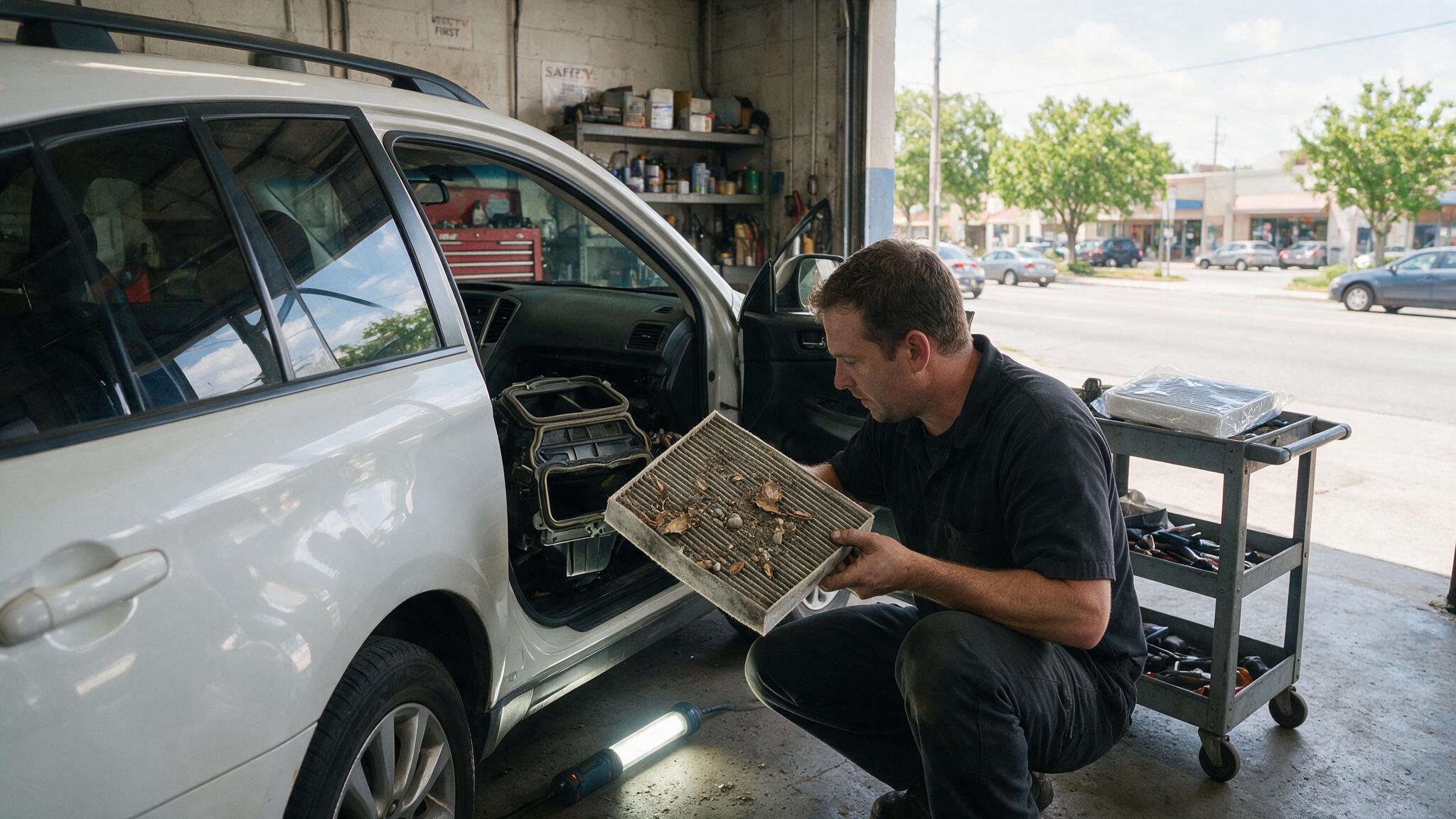
Why Does My Car AC Smell Bad?
A bad smell from your car’s A/C can have several causes, and the odor itself doesn’t identify one specific problem. Musty smells can be associated with moisture and the HVAC system, while a dirty cabin air filter or other HVAC conditions can also contribute to unpleasant odors. If the smell keeps returning, becomes unusually strong, or appears along with reduced airflow or other A/C problems, the system should be inspected rather than simply masking the odor.
The first step is to pay attention to what the smell is like, when you notice it, and whether it changes when the A/C or blower is operating.
What causes a bad smell from car AC?
An unpleasant A/C smell can originate from several areas of the vehicle’s HVAC system.
Possible causes include:
- Moisture within the HVAC system
- A dirty or overdue cabin air filter, where equipped
- Odors associated with the evaporator or surrounding HVAC components
- Debris entering the HVAC airflow path
- Conditions that allow an odor to persist inside the ventilation system
- Other HVAC or cabin-air issues
A musty odor does not automatically prove that mold is present.
Likewise, a dirty cabin air filter isn’t automatically responsible for every A/C smell.
The odor is a symptom. Finding its source requires looking at the HVAC system and the conditions under which the smell occurs.
Why does my car AC smell musty?
A musty smell is commonly associated with moisture in or around the HVAC system.
Your vehicle’s A/C system handles moisture as part of the cooling process. Under appropriate conditions, moisture can collect and drain from the system.
If an odor develops around the HVAC system, you may notice it most clearly when the blower or A/C first starts operating.
However, a musty smell doesn’t tell you exactly where the odor originates.
Potential areas to investigate include:
- Cabin air filter
- Evaporator area
- HVAC housing
- Airflow passages
- Moisture-related conditions within the system
A technician can determine whether the odor appears to be coming from the HVAC system and what service, if any, is appropriate.
Does a dirty cabin air filter cause AC smell?
It can contribute to unpleasant odors, particularly if the filter is dirty or has accumulated material over time.
The cabin air filter is part of the vehicle’s air-intake and filtration system where the vehicle is equipped with one.
A filter that is heavily soiled may also affect airflow.
But there is an important distinction:
Replacing the cabin air filter may address a filter-related odor or airflow problem, but it doesn’t automatically resolve every source of HVAC odor.
If the smell remains after the filter is addressed, the rest of the HVAC system may need to be evaluated.
What does the cabin air filter do?
The cabin air filter helps filter air entering the passenger compartment through the HVAC system.
Depending on the vehicle, its design and replacement requirements can vary.
A filter can collect dust, debris, pollen and other airborne material over time.
That makes the filter worth checking when a vehicle develops:
- An unusual cabin odor
- Reduced airflow
- A visibly dirty filter
- Other changes in HVAC performance
Vehicle-specific replacement guidance should be checked against the manufacturer’s recommendations.
Can the evaporator cause a bad smell?
The evaporator is part of the vehicle’s A/C system and is located within the HVAC system.
Because the A/C process involves moisture, conditions around the evaporator and HVAC housing can be relevant when investigating certain odors.
However, it’s not accurate to assume that every musty smell means the evaporator itself is contaminated or defective.
An evaporator-related odor is one possibility among several, and the HVAC system needs to be evaluated before identifying the source.
Why does the AC smell worse when I first turn it on?
If an odor is strongest when the A/C or blower first starts, the HVAC system is immediately moving air from the ventilation system into the cabin.
That can make an existing odor much more noticeable.
You may find that the smell:
- Is strongest for the first few moments
- Becomes less noticeable afterward
- Returns every time the vehicle sits for a while
- Changes depending on whether A/C or ventilation is selected
The pattern can provide useful information.
It doesn’t, by itself, identify the source.
Why does my car AC smell like mildew?
A mildew-like or musty odor can be associated with moisture-related conditions in the HVAC system.
But the smell alone isn’t enough to establish that mildew or mold is present.
Other sources can produce similar odors.
If the smell is persistent, unusually strong, or keeps returning, the HVAC system should be inspected rather than making assumptions based solely on the odor.
Can a dirty air filter make my car smell bad?
Yes, a dirty cabin air filter can contribute to an unpleasant smell.
The filter sits in the HVAC airflow path on vehicles equipped with one, so accumulated material can affect the air entering the cabin.
A dirty filter can also be relevant when airflow becomes weaker.
If you notice both an unusual odor and reduced airflow, checking the cabin air filter according to the vehicle manufacturer’s procedure can be a sensible first step.
What can I safely check myself?
There are a few simple observations you can make without opening the A/C system.
Pay attention to the smell
Try to describe it:
- Musty
- Damp
- Dusty
- Chemical-like
- Burnt
- Exhaust-like
- Sweet
- Another unusual odor
The description can help a technician understand the complaint.
Don’t assume the smell identifies the failed component.
Notice when it happens
Ask yourself:
- Does it happen only when the A/C is running?
- Does it happen when the blower runs without A/C?
- Is it strongest when first starting the system?
- Does it happen every time?
- Does it occur after the vehicle has been parked?
- Does it disappear after the system runs for a while?
These details can be more useful than simply saying that the A/C smells bad.
Check the cabin air filter if your vehicle provides safe access
If your vehicle’s owner’s manual provides a straightforward procedure for checking or replacing the cabin air filter, you can follow that procedure.
Look for obvious dirt or debris.
Don’t disassemble HVAC components or attempt to access the evaporator or refrigerant system yourself.
Should I replace my cabin air filter?
If the filter is dirty and the vehicle manufacturer’s maintenance procedure calls for replacement, replacing it may improve airflow and address an odor associated with the filter.
But don’t assume the filter is the complete solution.
If the odor continues afterward, the HVAC system may need further inspection.
Vehicle-specific filter locations and service intervals vary, so check the owner’s manual or manufacturer guidance for your vehicle.
When should a technician inspect the AC?
Consider having the HVAC system inspected if:
- The smell keeps returning.
- The odor is unusually strong.
- The smell doesn’t improve after addressing a dirty cabin air filter.
- Airflow has become weaker.
- The A/C also has cooling problems.
- You notice an unusual smell that you can’t identify.
- The odor appears to come from somewhere other than the normal HVAC airflow.
- The problem is getting progressively worse.
A technician can determine whether the issue appears to involve the cabin air filter, HVAC housing, evaporator area, airflow path, or another part of the vehicle.
What should a technician check?
A technician can approach an A/C odor complaint systematically.
Cabin air filter
If the vehicle has a cabin air filter, its condition can be evaluated.
The technician can look for excessive dirt, debris, moisture, or other obvious conditions.
HVAC airflow path
The ventilation system can be evaluated for conditions that may contribute to the odor.
Evaporator and HVAC housing
Where appropriate, the technician may inspect accessible components or use an appropriate diagnostic/service procedure to evaluate the source of the odor.
Moisture-related conditions
Because moisture is part of normal A/C operation, the technician can consider whether moisture-related conditions could be contributing to the complaint.
A/C performance
If the odor occurs alongside poor cooling, weak airflow, or another A/C symptom, the broader A/C system may need to be evaluated rather than treating the smell as an isolated problem.
What if the smell isn’t actually coming from the AC?
That’s an important possibility.
A smell coming through the vents doesn’t necessarily mean the A/C system itself is the source.
Other vehicle systems or outside odors can enter the cabin through the HVAC air intake.
If the odor is:
- Exhaust-like
- Fuel-like
- Strongly chemical
- Burnt or electrical
- Associated with smoke
- Accompanied by another warning sign
don’t assume it’s a normal A/C odor.
An unfamiliar or potentially hazardous smell should be taken seriously and evaluated promptly.
If you suspect exhaust entering the cabin, stop using the vehicle until the source can be safely evaluated.
Can Houston heat make AC odors worse?
Houston’s hot weather can increase A/C use and create conditions where drivers notice HVAC odors more frequently.
Vehicles parked outside can also develop substantial cabin heat before the A/C is turned on.
That doesn’t mean Houston heat itself causes a particular odor.
Instead, heavy A/C use and hot conditions can make an existing HVAC odor more noticeable to the driver.
For Houston drivers, the useful question remains:
Has the odor changed, and does it consistently occur when the HVAC system operates?
What can make an AC smell problem worse?
Ignoring a recurring odor
If the smell disappears temporarily but keeps returning, don’t assume the problem has permanently resolved.
Replacing only the filter when the smell persists
A filter can contribute to an odor, but it isn’t the only possible source.
Masking the smell
Air fresheners may cover an odor without addressing its source.
Assuming “musty” means mold
A musty smell can have multiple causes. The odor alone doesn’t establish the presence of mold or another specific contaminant.
Ignoring other symptoms
If the odor occurs together with weak airflow, poor cooling, water-related concerns, unusual noises, or another HVAC symptom, the broader system deserves attention.
How can I help prevent car AC odors?
Practical maintenance starts with following the manufacturer’s recommendations for your vehicle.
Useful habits include:
- Check or replace the cabin air filter according to vehicle-specific guidance.
- Pay attention to changes in HVAC airflow.
- Don’t ignore recurring odors.
- Keep obvious debris away from HVAC intake areas where accessible.
- Have persistent HVAC odors evaluated.
- Follow manufacturer guidance for A/C and HVAC maintenance.
There isn’t one universal filter replacement interval that applies to every vehicle, so vehicle-specific guidance should take priority.
Does a bad AC smell mean I need an AC repair?
Not necessarily.
A smell may be associated with a cabin air filter or another relatively straightforward HVAC service issue.
But a persistent odor can also require a closer look at the HVAC system.
The right service depends on the actual source.
The goal should be to identify the source of the odor before deciding whether the vehicle needs a filter replacement, HVAC cleaning/service, A/C repair, or another type of inspection.
Quick Wrench perspective
When a driver says, “My AC smells bad,” the first useful question isn’t necessarily what part needs replacing.
It’s:
What does it smell like, and when does the smell happen?
A musty smell that appears when the blower starts is a different diagnostic clue from a burnt smell that appears while the vehicle is operating.
Likewise, an odor accompanied by weak airflow gives the technician more information than an odor alone.
The cabin air filter is worth considering, but it shouldn’t become a default answer for every A/C odor complaint.
The most useful approach is to describe the odor and its pattern accurately, then have the HVAC system inspected if the problem persists.
Frequently Asked Questions
Why does my car AC smell bad when I first turn it on?
An odor can be especially noticeable when the HVAC system first begins moving air through the cabin. Moisture-related conditions, the cabin air filter, and other HVAC components can contribute to the smell.
Why does my car AC smell musty?
A musty smell can be associated with moisture-related conditions in the HVAC system, but it can also have other causes. The odor alone doesn’t prove mold or identify a specific component.
Can changing the cabin air filter fix AC smell?
It can if the filter is contributing to the odor. If the smell continues after the filter is addressed, the HVAC system may need further inspection.
Does a bad AC smell mean there is mold?
No. A musty odor does not by itself establish that mold is present. There are several possible sources of unpleasant HVAC odors.
Why does my AC smell worse after my car sits?
A smell may become more noticeable when the HVAC system first starts moving air after the vehicle has been parked. The vehicle’s cabin and HVAC system may also have been exposed to heat and moisture during that period.
Should I get my car AC checked if it smells bad?
If the odor is persistent, keeps returning, is unusually strong, or occurs alongside poor cooling or weak airflow, an HVAC inspection is a sensible next step.
Have the HVAC System Inspected
If your car’s A/C smells bad, don’t simply cover the odor with an air freshener or assume you need one specific repair.
Have the HVAC system inspected by Quick Wrench to help identify the source of the odor and determine what service is actually needed.
Ready to Find Out What’s Wrong?
Let our team inspect your vehicle’s A/C system and identify what may be affecting its cooling performance.
Book an A/C Inspection