
Car AC Cold While Driving but Warm at Idle: What It Means
If your car’s A/C blows cold air while you’re driving but becomes warm when you stop or sit at idle, the change in airflow through the A/C condenser is an important clue. One common possibility is inadequate condenser airflow, which can involve a cooling fan or airflow restriction. Low refrigerant, compressor problems, or other A/C faults can produce similar symptoms, so the symptom alone does not prove which component has failed.
Why does car AC get cold while driving but warm at idle?
The difference between driving and idling matters because the A/C condenser depends on airflow to release heat from the refrigerant.
When the vehicle is moving, air naturally passes through the grille and across the condenser. When the vehicle stops, that natural airflow largely disappears, so the vehicle’s cooling fan system has to provide the necessary airflow.
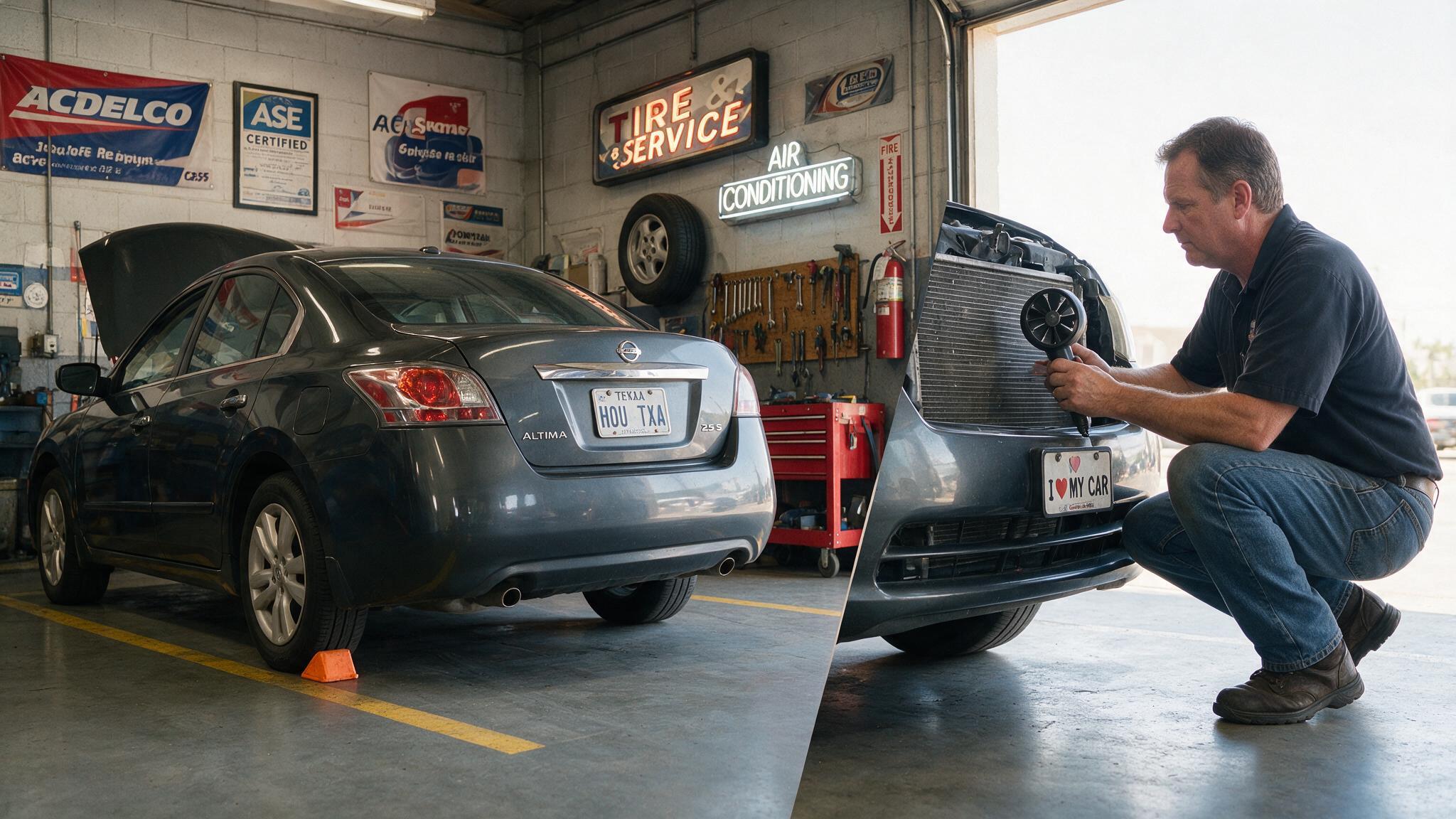
The condenser is located toward the front of the vehicle and releases heat from the refrigerant to the outside air. Cooling fans help provide airflow when the vehicle is stationary. (DENSO)
If your A/C is cold while driving but becomes warm at a stop, inadequate condenser airflow is one of the first areas a technician should investigate. However, it is not the only possible cause.
Why does airflow matter so much?
The A/C system transfers heat from inside the cabin to the outside environment.
In simplified terms:
- The compressor circulates and pressurizes the refrigerant.
- The refrigerant carries heat toward the condenser.
- The condenser releases that heat into the outside air.
- The refrigerant continues through the system so the cycle can repeat.
If the condenser cannot get rid of heat effectively, A/C performance can suffer. DENSO notes that contamination or restricted airflow around the condenser can increase condensing pressure and reduce cooling performance. (Denso AM)
What can cause AC to be warm at idle?
Several problems can create this symptom.
| Symptom or condition | Possible area to inspect |
|---|---|
| Cold while driving, warm when stopped | Condenser airflow and cooling fan operation |
| A/C gradually becomes warmer in traffic | Condenser airflow, system pressures, refrigerant condition |
| A/C is warm both driving and idling | Refrigerant, compressor, controls, airflow or other A/C components |
| Weak air coming from the vents | Cabin airflow, blower or cabin filter |
| Cooling changes intermittently | Electrical controls, fan operation, compressor operation or refrigerant condition |
| Unusual A/C noises | Compressor, pulley, fan or other components |
These are diagnostic starting points, not automatic diagnoses. Several A/C problems can produce similar symptoms.
Could the condenser fan be the problem?
Yes. A cooling or condenser fan problem is a particularly important possibility when the A/C works better at speed and becomes warmer after the vehicle stops.
Many vehicles use a cooling fan to move air through the radiator and condenser when the vehicle isn’t getting enough natural airflow from driving. Some vehicles use multiple fans or different fan-control strategies depending on the vehicle design. (Napa Online)
A fan problem could involve the fan motor, electrical circuit, control system, damaged fan blades, or another component controlling fan operation.
A restricted condenser can create a similar problem. Dirt, debris, bent fins, or contamination between the condenser and radiator can interfere with airflow. DENSO specifically recommends checking the condenser and radiator for contamination and checking cooling-fan operation during A/C diagnosis. (Denso AM)
What happens when the fan isn’t providing enough airflow?
At highway speed, natural airflow can temporarily compensate for a weak or non-functioning fan.
At a traffic light, in a parking lot, or in stop-and-go traffic, that airflow decreases. If the cooling system cannot maintain the necessary airflow through the condenser, A/C performance may decline.
That is why the driving-versus-idle pattern itself is useful diagnostic information.
Could low refrigerant cause AC to get warm at idle?
It can. Low refrigerant can affect A/C performance, but adding refrigerant should not automatically be the first response.
A refrigerant system is designed to operate with a specified refrigerant charge. If the charge is low, the underlying reason may be a leak or another system problem.
A proper diagnosis can include checking the system’s operating condition and looking for evidence of refrigerant leakage. DENSO recommends checking for refrigerant leaks as part of A/C service and notes that more than one leak-detection method may be appropriate. (DENSO)
If an A/C system is low on refrigerant, simply adding refrigerant without determining why the charge is low may leave the underlying problem unresolved.
The correct refrigerant and service procedure also depend on the vehicle. Do not assume that refrigerant type, charge amount, or service procedure is universal.
Could the A/C compressor be causing the problem?
The compressor is another component that needs to be considered.
The compressor circulates refrigerant through the A/C system and sends it toward the condenser. If compressor operation is inadequate, the system may not cool properly. (DENSO)
However, replacing a compressor based solely on the symptom would be premature.
A technician should evaluate the complete system before deciding that the compressor is responsible. Other faults can produce similar cooling symptoms.
Could a dirty condenser cause warm A/C at idle?
Yes.
The condenser needs effective airflow to release heat. Dirt, debris, bent fins, or contamination between the condenser and radiator can restrict that airflow.
This can become particularly noticeable when the vehicle is stationary because there is less natural airflow than when driving.
A quick visual inspection may reveal obvious debris at the front of the condenser, but the absence of visible debris does not rule out an airflow or A/C problem. Some restrictions can occur between components or require closer inspection. (Denso AM)
What can I safely check myself?
There are a few basic observations you can make without opening or servicing the A/C system.
1. Pay attention to exactly when the temperature changes
Notice whether the A/C:
- Gets warm immediately when you stop
- Takes several minutes to become warm
- Gets warm only in heavy traffic
- Becomes cold again as soon as you start moving
- Remains warm after you resume driving
That information can help a technician narrow down the problem.
2. Look for obvious debris at the front of the vehicle
With the engine off and the vehicle safely parked, you can visually check the grille area for obvious leaves, dirt or other debris obstructing airflow.
Do not reach into the cooling-fan area.
3. Check whether airflow from the cabin vents is strong
If the air is blowing strongly but isn’t cold, the issue may be different from a situation where very little air is coming from the vents.
Cabin airflow can be affected by components such as the cabin filter or blower system. (DENSO)
What should you not do?
Do not open refrigerant lines, attempt to release refrigerant, or work around moving cooling fans without the proper training and equipment.
Cooling fans can operate unexpectedly on some vehicles, even when you are not expecting them to run. (KnowHow)
Refrigerant systems are also pressurized and should be serviced using the appropriate equipment and procedures.
What should a technician inspect?
A proper A/C diagnosis should look at the complete system rather than simply adding refrigerant.
Depending on the vehicle and symptoms, a technician may evaluate:
- Condenser airflow
- Cooling-fan operation
- Condenser condition
- Airflow restrictions
- Refrigerant condition and possible leaks
- Compressor operation
- A/C system pressures
- Electrical controls
- Cabin airflow
- Air-mixing or HVAC controls
- Unusual noises or other abnormal operation
DENSO’s A/C service guidance similarly includes checking system components, refrigerant leakage, condenser condition, condenser-fan operation, airflow, and overall A/C operation. (DENSO)
Why shouldn’t you just replace the fan?
Because the fan may not be the actual cause.
For example, an airflow problem could involve the fan, its electrical control, a damaged component, a restricted condenser, or another part of the A/C system.
The goal of diagnosis is to identify why the system isn’t performing correctly, rather than replacing parts based on one symptom.
Why Houston heat can make the symptom more noticeable
Houston drivers put substantial demand on their vehicle A/C systems during hot weather.
When the outside temperature is high, the A/C system has to move heat from the cabin into an already-hot environment. Effective condenser airflow therefore matters.
Stop-and-go traffic adds another variable: the vehicle is spending more time at low speed, where natural airflow through the front of the vehicle is reduced.
That does not mean Houston heat automatically causes an A/C failure. It means an existing weakness in airflow, cooling, or system operation can become more noticeable under demanding conditions.
When should you have the A/C inspected?
Consider having the vehicle inspected if:
- The A/C consistently becomes warm at idle.
- Cooling improves noticeably when you start driving.
- The problem is becoming more frequent.
- The A/C stops cooling effectively in traffic.
- You hear unusual noises when the A/C is operating.
- You notice other cooling-system problems.
- The engine temperature is also behaving abnormally.
- You suspect the system has lost refrigerant.
If the vehicle is overheating or showing signs of an engine cooling problem at the same time, don’t treat it as only an A/C issue. The vehicle should be evaluated promptly.
How can you help prevent A/C problems?
There isn’t a universal maintenance interval that guarantees an A/C system will remain trouble-free. Follow the vehicle manufacturer’s maintenance recommendations and pay attention to changes in performance.
Useful habits include:
- Have unusual A/C performance investigated rather than repeatedly adding refrigerant.
- Keep the front of the vehicle reasonably clear of accumulated debris.
- Replace the cabin air filter according to the vehicle manufacturer’s recommendations when equipped.
- Pay attention to new noises or changes in airflow.
- Have leaks diagnosed rather than ignoring a recurring loss of cooling.
- Have the system checked if cooling performance changes significantly.
Regular inspection can also identify airflow restrictions or component problems before they develop into larger issues. DENSO recommends checking filters, system components, condenser condition, refrigerant leakage and fan operation as part of A/C service. (DENSO)
Quick Wrench perspective
The most useful information you can give an automotive technician is often when the problem happens.
“AC isn’t cold” is useful, but:
“The A/C is cold when I’m driving, but after I stop at a light it gets warm, then gets cold again when I start moving.”
is a much more specific symptom.
That driving-versus-idle pattern gives the technician a better starting point for evaluating condenser airflow and the rest of the A/C system.
The important thing is not to assume the answer before the system is tested.
Frequently Asked Questions
Why is my car AC cold on the highway but warm at stoplights?
One possibility is inadequate airflow through the A/C condenser when the vehicle is stationary. The cooling fan, condenser condition, airflow restrictions, refrigerant condition and other components may need to be evaluated.
Should the AC fan run when the car is idling?
Many vehicles use cooling fans to provide airflow when the vehicle is stationary, but fan operation varies by vehicle design and control strategy. A technician should verify the expected operation for the specific vehicle rather than assuming every fan must operate continuously. (DENSO)
Does low refrigerant make AC warm at idle?
Low refrigerant can contribute to poor A/C performance, but warm A/C at idle does not by itself prove that the system is low on refrigerant. The system should be properly tested and checked for possible leaks.
Can a dirty condenser make my AC warm?
Yes. Dirt or other contamination can restrict airflow through the condenser and reduce its ability to release heat. (Denso AM)
Is it safe to check the AC cooling fan myself?
You can observe the vehicle’s behavior and visually inspect for obvious problems from a safe position, but avoid putting your hands near cooling fans. Some fans can start automatically, and A/C systems contain pressurized refrigerant. (KnowHow)
Should I add refrigerant if my AC gets warm at idle?
Don’t assume that adding refrigerant will solve the problem. A/C performance can be affected by airflow, fan operation, refrigerant condition, compressor operation and other faults. Proper diagnosis should come before adding or recovering refrigerant.
Need your A/C checked?
If your A/C is cold while driving but becomes warm when you’re sitting at idle, the pattern is worth having diagnosed rather than guessing which component needs replacement.
Schedule an A/C diagnostic with Quick Wrench and have the system checked for the underlying cause.
Ready to Find Out What’s Wrong?
Let our team inspect your vehicle’s A/C system and identify what may be affecting its cooling performance.
Book an A/C Inspection