
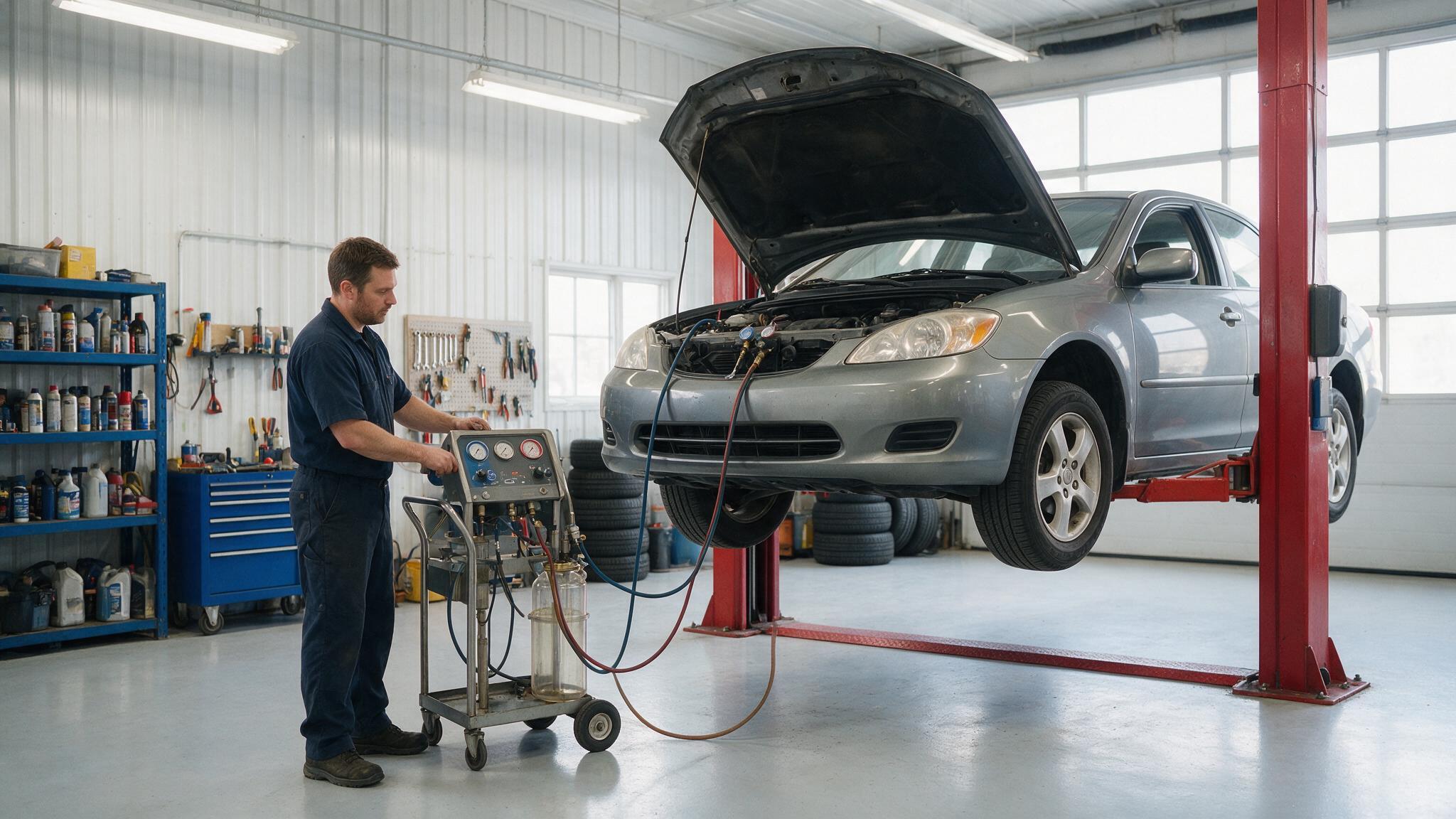
Does My Car AC Need Refrigerant or a Repair?
If your car’s A/C isn’t blowing as cold as it used to, it may need refrigerant—but it may also have a leak or another A/C problem that requires repair. Refrigerant isn’t normally something an A/C system simply “uses up,” so a low charge should prompt a search for the reason it is low rather than automatically assuming the system only needs a recharge.
The right next step is to diagnose the system before adding refrigerant or replacing parts.
How do I know if my car AC needs refrigerant?
Weak or warm A/C can be associated with low refrigerant, but the symptoms aren’t specific enough to confirm it by themselves.
Other possible causes include:
- A refrigerant leak
- Compressor problems
- Condenser airflow problems
- Cooling-fan problems
- Electrical or control faults
- Restricted cabin airflow
- HVAC or temperature-control problems
- Other A/C system component failures
Warm air from the vents does not automatically mean the vehicle needs an A/C recharge. The system needs to be evaluated to determine whether refrigerant level, a leak, airflow, compressor operation, or another component is responsible.
That distinction matters because adding refrigerant to a system with an unresolved leak may only provide temporary improvement.
Does car AC refrigerant run out?
Normally, refrigerant circulates through a closed A/C system. It isn’t consumed in the same way fuel is consumed by an engine.
If the system has lost a significant amount of refrigerant, there may be a leak or another condition that needs investigation.
That is why repeated A/C recharges aren’t a good substitute for diagnosis.
What does low refrigerant actually mean?
A low refrigerant charge means the system doesn’t contain the amount of refrigerant it was designed to operate with.
That can affect the system’s ability to transfer heat and produce cold air.
But there is an important distinction:
Low refrigerant is a condition, not necessarily the root cause. The next question should be why the refrigerant level is low.
If there is a leak, the leak needs to be identified and addressed using the appropriate service procedure.
What are signs my car AC may be low on refrigerant?
Possible signs include:
- A/C isn’t as cold as it normally is.
- Cooling performance gradually decreases.
- The system blows cool rather than consistently cold air.
- Cooling performance changes under different driving conditions.
- The A/C stops cooling effectively.
- A technician finds evidence of insufficient refrigerant during diagnosis.
However, these symptoms can overlap with other A/C problems.
For example, an airflow problem or compressor issue can also cause poor cooling. That’s why symptoms are useful for narrowing the diagnostic path but shouldn’t be treated as proof of a specific failure.
How does a refrigerant leak happen?
An A/C system contains multiple components, connections and seals. A leak can develop in different areas of the system.
Potential leak locations can include components such as:
- Hoses and lines
- Connections
- O-rings and seals
- Condenser
- Evaporator
- Compressor
- Other A/C components
The actual leak location depends on the vehicle and the condition of its A/C system.
A visual inspection may reveal signs of a problem, but some leaks are difficult to locate without appropriate diagnostic equipment.
Why shouldn’t I just recharge the AC?
Because a recharge addresses the refrigerant charge, not necessarily the reason the refrigerant became low.
Consider two different situations:
| Situation | What may be needed |
|---|---|
| System has correct refrigerant charge but A/C isn’t cold | Diagnosis of other system components |
| System has low refrigerant | Determine why the charge is low |
| Low refrigerant caused by a confirmed leak | Leak diagnosis and appropriate repair/service |
| A/C problem caused by compressor or control fault | Diagnosis and repair of the affected system |
| Poor condenser airflow | Inspection of airflow and cooling-fan operation |
This is why “just add refrigerant” can be the wrong approach.
If refrigerant is low, the important question isn’t only “How much should we add?” It’s also “Why did the system lose refrigerant?”
Is checking AC pressure enough to diagnose the problem?
No. Pressure readings can provide useful diagnostic information, but a pressure reading by itself does not necessarily identify the cause of poor A/C performance.
A technician needs to consider the vehicle, operating conditions, system design and other observations when interpreting pressure measurements.
For example, abnormal pressure can be associated with different conditions depending on the system and circumstances.
A proper diagnosis may combine:
- System pressures
- Refrigerant condition
- Leak checks
- Compressor operation
- Condenser airflow
- Cooling-fan operation
- Cabin airflow
- Electrical controls
- Temperature observations
- Visual inspection
A pressure reading is one piece of diagnostic information, not a complete diagnosis.
What can I safely check myself?
You can make several useful observations without opening or servicing the refrigerant system.
Pay attention to the temperature
Notice whether the A/C:
- Is completely warm
- Is cool but not cold
- Starts cold and becomes warm
- Gets warm at idle
- Gets colder while driving
- Works intermittently
- Takes unusually long to cool the cabin
The exact pattern can help a technician determine where to start.
Check cabin airflow
Notice whether air is coming from the vents with normal strength.
There is an important difference between:
Strong airflow that isn’t cold
and
Very weak airflow that may not be moving enough air through the cabin.
Those symptoms can point toward different areas of the vehicle.
Look for obvious signs around the vehicle
With the vehicle safely parked and the engine off, you can visually inspect accessible areas for obvious damage or debris.
Do not open refrigerant lines or attempt to discharge or recharge the system yourself without the appropriate equipment and training.
What should a technician check?
A proper A/C inspection should be systematic.
Depending on the vehicle and symptoms, a technician may check:
1. Refrigerant condition
The system can be evaluated to determine whether the refrigerant charge is appropriate for the vehicle and whether there are indications of a loss of charge.
Vehicle-specific refrigerant requirements and service procedures should be verified against manufacturer information.
2. Evidence of leaks
If the system is low, leak detection becomes important.
The technician may use appropriate leak-detection methods depending on the vehicle and system.
The objective is to find the source rather than repeatedly replacing lost refrigerant.
3. Compressor operation
The compressor is central to the refrigeration cycle.
A technician may evaluate whether it is operating correctly and whether there are signs of mechanical, electrical or control problems.
4. Condenser and airflow
The condenser needs adequate airflow to release heat.
The inspection may include the condenser’s condition, airflow restrictions and cooling-fan operation.
5. Cabin airflow
The technician may also evaluate whether air is moving properly through the cabin and whether components affecting airflow are operating correctly.
6. Electrical and HVAC controls
Modern vehicles can use electronic controls to manage A/C operation.
An electrical or control fault can therefore create an A/C complaint even when refrigerant isn’t the underlying problem.
What can make an AC problem worse?
Several common approaches can delay the actual repair.
Repeatedly adding refrigerant
If the system has a leak, repeatedly adding refrigerant doesn’t address the source of the loss.
Assuming warm air always means low refrigerant
There are multiple reasons an A/C system can produce warm air.
Replacing the compressor without diagnosis
A compressor can fail, but other components can create similar symptoms. Replacing an expensive component without confirming the cause can result in unnecessary work.
Ignoring a gradually worsening problem
A/C performance that slowly declines is useful information. Waiting until the system stops cooling completely can make diagnosis less convenient and may allow an underlying problem to continue.
Why Houston drivers should pay attention to A/C changes
Houston’s hot weather can make a marginal A/C problem much more noticeable.
When outside temperatures are high, the A/C system has to remove heat from the passenger compartment and reject that heat into the outdoor environment.
Drivers also encounter stop-and-go traffic, long commutes and extended periods of A/C use.
That doesn’t mean every Houston A/C problem is caused by heat. It does mean that changes in cooling performance can become particularly noticeable when the system is working hard.
If your A/C used to cool the cabin quickly but now struggles during a hot Houston afternoon, that’s useful information to mention when scheduling an inspection.
When should I get my car AC inspected?
An A/C inspection is worth considering if:
- The system isn’t cooling like it normally does.
- The A/C becomes warm intermittently.
- Cooling gets worse over time.
- You repeatedly need refrigerant added.
- The system stops cooling altogether.
- You hear unusual noises when the A/C operates.
- The A/C works differently at idle versus while driving.
- You suspect there may be a refrigerant leak.
If the A/C problem is accompanied by engine overheating or another cooling-system warning, don’t assume it is simply an air-conditioning issue. Have the vehicle evaluated.
How can I avoid unnecessary AC repairs?
The best way to avoid unnecessary parts replacement is to start with the symptom and diagnose the system before deciding what needs to be replaced.
You can help by telling the technician:
- When the problem started
- Whether cooling has gradually declined or failed suddenly
- Whether it happens at idle, while driving, or both
- Whether the A/C works intermittently
- Whether the system has previously been recharged
- Whether you have noticed unusual noises
- Whether anything was recently repaired around the A/C system
These details can make the diagnostic process more focused.
Quick Wrench perspective
There is an important difference between servicing an A/C system and diagnosing why an A/C system isn’t cooling.
If a vehicle has lost refrigerant, simply restoring the charge may not answer the bigger question: why was the system low?
A better approach is to look at the complete symptom, check the system properly, and determine whether the problem is refrigerant-related or requires another repair.
That’s especially important when the A/C problem keeps returning.
Frequently Asked Questions
How often does a car AC need a refrigerant recharge?
There isn’t a universal recharge interval that applies to every vehicle. A properly functioning closed A/C system should not normally require routine refrigerant additions simply because time has passed. If the refrigerant charge is low, the cause should be investigated.
How do I know if my car has an AC refrigerant leak?
Poor cooling can be one indication, but it does not prove a leak. A proper A/C inspection can look for evidence of refrigerant loss and use appropriate leak-detection methods when needed.
Can I recharge my car AC myself?
A/C refrigerant systems are pressurized and require appropriate equipment and procedures. Opening or servicing the refrigerant circuit is not a good DIY project for someone without the necessary training and equipment.
Does low refrigerant damage the AC compressor?
The relationship depends on the vehicle and A/C system. Because refrigerant level and compressor operation are connected within the system, an A/C problem should be diagnosed rather than assuming that low refrigerant will automatically produce one specific type of damage.
Why does my AC get colder when I drive?
If an A/C system performs differently while driving versus sitting at idle, condenser airflow and cooling-fan operation may be relevant. Other system problems can also produce changing performance, so the vehicle should be diagnosed based on its specific symptoms.
Should I get an AC recharge or an inspection?
If you don’t know why the A/C is low or isn’t cooling correctly, an inspection is the better starting point. It can help determine whether the system actually needs refrigerant and whether an underlying leak or another fault needs attention.
Need your A/C checked?
If your car’s A/C isn’t cooling properly, don’t assume it just needs more refrigerant.
Get the A/C system inspected by Quick Wrench so the underlying problem can be identified before deciding what service is needed.
Ready to Find Out What’s Wrong?
Let our team inspect your vehicle’s A/C system and identify what may be affecting its cooling performance.
Book an A/C Inspection